
Masjid Nabawi
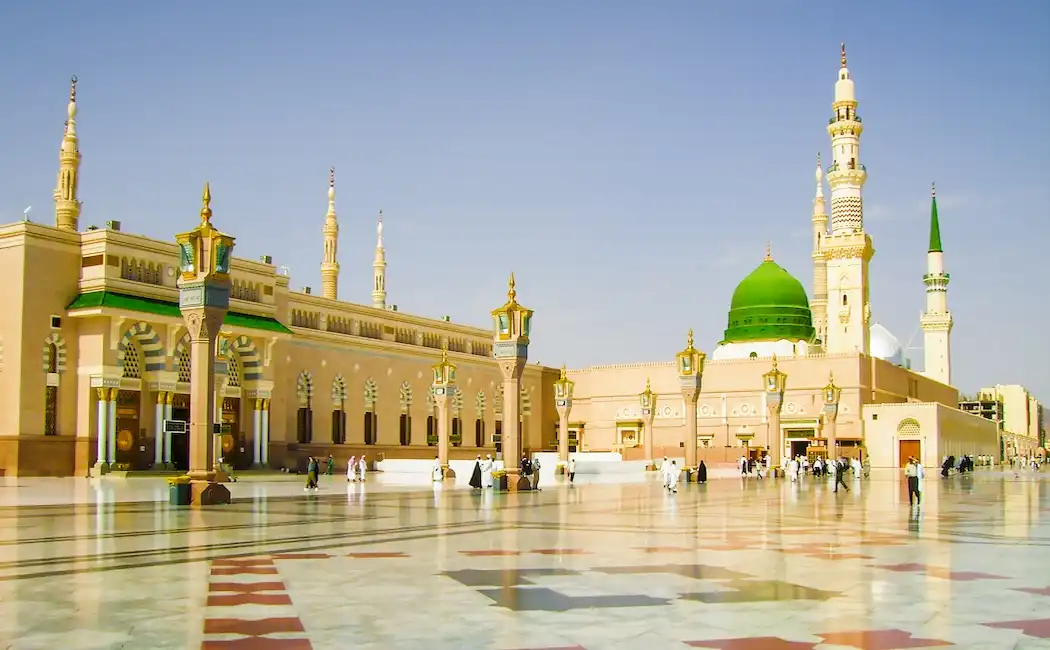
Masjid Nabawi
Masjid Nabawi
One of the first activities carried out after the migration of the Prophet Muhammad (saw) from Mecca to Madinah, a turning point in Islamic history, was the construction of Masjid an-Nabawi (the Prophet’s Mosque). One of the two mosques personally built by the Prophet (saw) (the other being Masjid Quba), Masjid an-Nabawi served as the center of all his activities in Medina and set a precedent for the functions of mosques established in later periods. Although the name of Masjid an-Nabawi is not explicitly mentioned in the Qur’an, it is reported that the phrase
..the mosque founded on piety from the first day..(At-Tawba 9/108)
refers to either Masjid an-Nabawi or Masjid Quba (Musnad, III, 91; Muslim, “Hajj,” 514; Baladhuri, Futuh, p. 4; Tabari, Jami‘ al-Bayan, XI, 26-28).
Ibn Kathir states that Masjid an-Nabawi is more deserving of this description (Al-Bidaya, III, 218). According to most Islamic scholars, Masjid an-Nabawi ranks second in virtue after Masjid al-Haram in Makkah. However, some scholars, including Imam Malik, consider Masjid an-Nabawi to be more virtuous because the Prophet (saw) was buried there (Nawawi, IX, 163, 164). Like Masjid al-Haram in Mecca, the term Haram Sharif (Noble Sanctuary) is also used for Masjid an-Nabawi and Masjid al-Aqsa in Al Quds ( Jerusalem).
Before the Hijrah (migration), As‘ad ibn Zurara (r. anh), one of the first to pledge allegiance to the Prophet (saw) at Aqaba, had enclosed a date-drying area in Madinah with walls to create a mosque (Ibn Sa‘d, III, 457). When the Prophet (saw) entered Medina on Friday, 12 Rabi‘ al-Awwal (24 September 622), he allowed his camel, Qaswa, to roam freely to avoid disappointing those who invited him, stating he would stay at the house nearest to where the camel stopped. It is reported that during this time, the Prophet (saw) recited the prayer taught to Prophet Noah: “Ya Rabb! Cause me to land at a blessed landing place, for You are the best of those who bring to land” (Al-Mu’minun 23/29) (Samhudi, I, 322). When Qaswa stopped at a date-drying area in front of the houses of the Banu Malik ibn Najjar, Our beloved Nabi (saw) stayed as a guest with Abu Ayyub al-Ansari (r. anh), the owner of the nearest house. The Prophet (saw) purchased this plot, which belonged to two orphans named Sahl and Suhayl under the care of As‘ad ibn Zurara (r. anh), Mu‘adh ibn Afra (r. anh), or Abu Ayyub al-Ansari (r. anh), for 10 dinars to build a mosque (Bukhari, “Manaqib al-Ansar,” 45; Baladhuri, Futuh, p. 6). There is also a report that the owners donated the land for the mosque (Bukhari, “Wasaya,” 30; Tabari, Tarikh, II, 397). After leveling the uneven and thorny terrain (Tabari, Tarikh, II, 396-397), the Prophet (saw) laid the first stone for the foundation, which was about 3 cubits deep.
Construction of Masjid an-Nabawi began in Rabi‘ al-Awwal (September 622) and was completed in Shawwal (April 623) under the leadership of the Prophet (saw), who worked alongside his companions, particularly Talk ibn Ali (r. anh) and Ammar ibn Yasir (r. anh). The construction provided an excellent opportunity for the integration of the Ansar and Muhajirun, encouraged by the Prophet’s (saw) kind words and poetry (Abd ar-Razzaq as-San‘ani, V, 396-397; Ibn Sa‘d, I, 185-186). The initial structure was built on a stone foundation with single-layer mudbrick walls, about the height of a man, enclosing an open area of 60 × 70 cubits (1022 m²) (Samhudi, I, 334). Variations in measurements mentioned in sources likely stem from differences in the cubit used and its metric equivalent. The mosque, oriented toward Al Quds ( Jerusalem ) as the qibla by the Prophet (saw) himself, had three gates. Two rooms (Hujurat- cells) were built for the Prophet’s (saw) wives, Ummuhat al Mu’minin Hazrat Aisha (r. anh) and Hazrat Sawda (r. anh), at the southern end of the eastern wall, with one door opening into the mosque. The number of these rooms later increased to nine.
When the qibla was changed to the Ka‘ba in Mecca sixteen or seventeen months after the migration, the gate on the new qibla side (south) was closed, and a new gate was opened in the northern wall. Simple yet highly functional, Masjid an-Nabawi could no longer accommodate the growing Muslim community, so it was expanded in the 7th year (628) after the return from Khaybar. At the Prophet’s (saw) encouragement, Uthman (r. anh) purchased adjacent plots to incorporate into the mosque (Musnad, I, 70; Tirmidhi, “Manaqib,” 19; Darqutni, IV, 195; Ahmad ibn Husayn al-Bayhaqi, VI, 167; Tabarani, I, 196). During this period, the mosque was expanded on three sides (except the qibla side) to form a square layout of 100 × 100 cubits (approximately 2433 m²) (Samhudi, I, 336, 338, 341).


