
Masjid Quba in Madinah
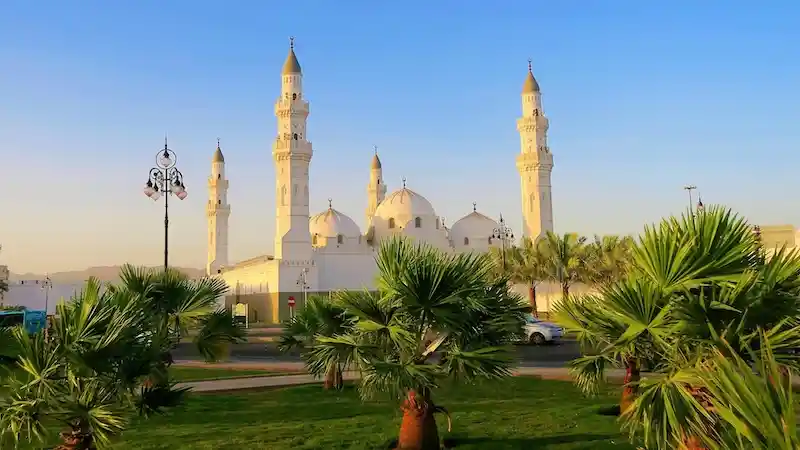
Masjid Quba in Madinah
Masjid Quba in Madinah
The first Muhajirun, before the Prophet Muhammad (saw) arrived in Madinah, had converted a date-drying area belonging to the Banu Amr ibn Awf in Quba into a mosque. Salim, the freed slave of Abu Hudhayfa (r. anh), led a group of Muhajirun in prayer here, facing Al Quds ( Jerusalem). When the Prophet (saw) reached Quba, he expanded this site and constructed Masjid Quba (Ibn Sa‘d, III, 87; IV, 311). It is reported that among those led in prayer by Salim were Abu Bakr (r. anh), Umar (r. anh), Abu Salama al-Makhzumi (r. anh), Zayd (r. anh), and Amir ibn Rabi‘a (r. anh) (Bukhari, “Ahkam,” 25), indicating that Salim continued this role during the time the Prophet (saw) and Abu Bakr (r. anh) stayed in Quba or for some time thereafter. Also known as Masjid Bani Amr ibn Awf (Musnad, II, 10; Ibn Shabba, I, 41), it is narrated that the land for Masjid Quba belonged to Kulthum ibn Hidm (r. anh), a prominent member of the tribe, who donated it for the mosque. Another narration suggests the land was a threshing ground belonging to a woman named Layya. Sa‘d ibn Haysama (r. anh), a leading figure of the tribe who hosted the Prophet (saw) in his house adjacent to the land in the direction of the qibla, likely spearheaded the establishment of the mosque, as it is attributed to him in narrations. On the other hand, the hypocrites ( mushriks) used the excuse, “Will we prostrate in the place where Layya tied her donkey?” to justify building the Masjid Dirar (Dirar Mosque) (Ibn Shabba, I, 54-55).
According to a narration by Tabarani, when the people of Quba requested the Prophet (saw) to build a mosque, he asked one of the companions present to ride a camel. First, Abu Bakr (r. anh) mounted it, but the camel did not move. Then Umar (r. anh) tried, but the camel still did not move. When Ali (r. anh), who had arrived in Quba, mounted it, the camel stood and walked. The Prophet (saw) instructed Ali (r. anh) to let go of the camel’s reins and ordered the mosque to be built on the land where the camel roamed (al-Mu‘jam al-Kabir, II, 246). The area in the center of the mosque was later called “Mabrak an-Naqa” (the place where the camel knelt) (Samhudi, II, 23).
According to a narration in Bukhari (“Manaqib al-Ansar,” 45), the Prophet (saw) stayed in Quba for more than ten nights, during which Masjid Quba was built. This aligns with Ibn Sa‘d’s report that the Prophet (saw) stayed in Quba for fourteen nights (at-Tabaqat, I, 235). There are also narrations stating that the Prophet (saw) stayed in Quba for as short as four days.
The initial form of the mosque consisted of four walls enclosing a square area. After preparing the land, the Prophet (saw) placed the first stone in the foundation, followed by Abu Bakr (r. anh), Umar (r. anh), Uthman (r. anh), and others, as instructed by him (Tabarani, II, 339). This practice is considered the origin of the tradition where state leaders lay the first mortar for scientific, religious, and national structures (Abdulhay al-Kattani, II, 301). While building Masjid Quba, the Prophet (saw) worked like a laborer. When others tried to take heavy stones from his hands to assist, he directed them to help someone else (Tabarani, XXIV, 317-318). It is narrated that Abdullah ibn Rawaha (r. anh) recited poetry, saying, “Those who participate in the mosque’s construction, whether standing or sitting, reciting the Qur’an, and not spending their nights in sleep, have attained salvation,” with the Prophet (saw) repeating the last word of each verse (Ibn Shabba, I, 52).
The Prophet (saw) likely rebuilt Masjid Quba after the qibla was changed to the Ka‘ba (623) (Samhudi, II, 16). During this reconstruction, a roof was added over the front wall and seven columns aligned parallel to it. The houses of Kulthum ibn Hidm (r. anh) and Sa‘d ibn Haysama (r. anh) were located to the south of the mosque, with a door opening from Sa‘d’s house into the mosque. Muslims would visit the houses where the Prophet (saw) stayed, then enter the mosque through the door on Sa‘d’s side and pray at the spot where the Prophet (saw) prayed, near the third column on the east side, known as “al-Ustuwanatu’l-Muhallaqa.” Later, this door was closed, and a new door was opened in the western wall of the mosque. It is said that Ammar ibn Yasir (r. anh) completed the mosque, earning him the distinction of being the first to build a mosque in Islam (Nuraddin al-Halabi, II, 236).
Masjid Quba holds great significance as the first public mosque built by Muslims in a free and secure environment. It is widely accepted that the mosque referred to in the Qur’an as “the mosque founded on piety from the first day” (At-Tawba 9/108) is Masjid Quba, although some narrations suggest it refers to Masjid an-Nabawi. A mihrab was later built at the spot in the mosque where the verse known as the “Ussisah Ayat” (At-Tawba 9/108) is believed to have been revealed.
Hadith sources, including Bukhari and Muslim, dedicate sections to the virtues of Masjid Quba, citing narrations that the Prophet (saw), while in Madinah, would visit Masjid Quba on Saturdays, sometimes Mondays, and on the 17th of Ramadan to pray. It is also reported that he supervised the educational activities held in the mosque and considered praying in Quba equivalent to performing an Umrah (Ibn Majah, “Iqamatu’s-Salat,” 197; Tirmidhi, “Mawaqitu’s-Salat,” 125). When Umar (r. anh) visited Masjid Quba, he would clean its dust and show great reverence for it.
Location of Masjid Quba Madinah


